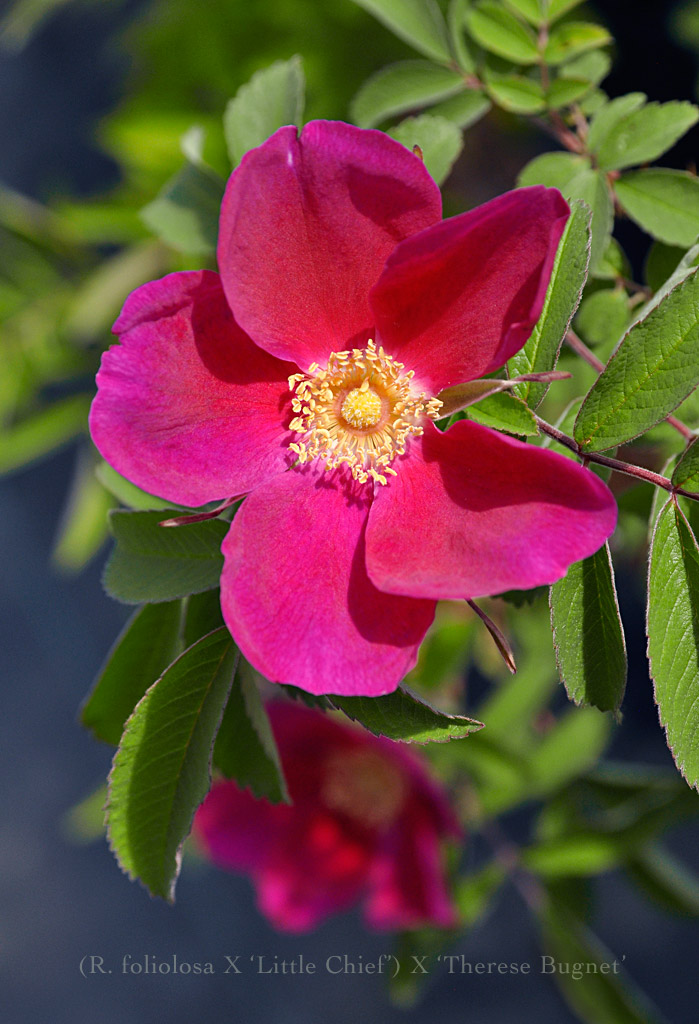
26-09-04, Parentage: 'Hansa' X "Magseed". Appearance-wise this is a completely unremarkable hybrid, but I value what it represents genetically. The pollen parent was given to me by it's creator Ralph Moore years ago; a cross of 'Anytime' and 'Rugosa Magnifica'. By crossing it back to an older "purebred" Rugosa I hoped to regain some of the Rugosa strength, character and, hopefully, health while infusing some of the modern miniature traits like generosity of bloom.
Clearly this seedling is not just a selfing of 'Hansa' since it has that odd "antler" pubescence often seen in Rugosa/modern hybrids. It has yet to be seen if this cultivar has merit as a garden shrub, but I plan on working it forward with other diploid breeding lines. I see a marriage with 'Therese Bugnet' in it's future.
Monday, August 8, 2011
Monday, June 27, 2011
Sabbatical
I am announcing my decision to take a sabbatical from rose hybridizing. This may in fact lead to "retirement" from the work in time; I am open to that possibility. Right now, I have ceased generating new seedlings will and spend the next two seasons evaluating what I already have. After that, who knows.
This "hobby" (for surely that is what I must call it since it doesn't pay for itself; it is a drain on my resources, both monetary and emotional) has reached a scale that is unmanageable and so I have to look very hard at what there is here and be ruthless in removing anything that does not approach perfection. (and since perfection is so very conspicuous by its absence from most roses, that ought to be easy enough) With any luck, this approach will reduce the volume of plants, and the associated work load, to a fraction of its current state. Then, and only then, will I consider resuming the making of new crosses and raising more seedlings. I may not resume at all. Only time will tell.
As regards this blog; I make no promises that I will continue to post information. I will if the mood hits me, but for the most part I will focus my energy on the work at hand: reducing my work load and hard culling of materials. Wish me luck. And thanks for reading and contributing to this blog for the past two years. It has been a pleasure engaging my readers.
Paul Barden
June 27, 2011.
This "hobby" (for surely that is what I must call it since it doesn't pay for itself; it is a drain on my resources, both monetary and emotional) has reached a scale that is unmanageable and so I have to look very hard at what there is here and be ruthless in removing anything that does not approach perfection. (and since perfection is so very conspicuous by its absence from most roses, that ought to be easy enough) With any luck, this approach will reduce the volume of plants, and the associated work load, to a fraction of its current state. Then, and only then, will I consider resuming the making of new crosses and raising more seedlings. I may not resume at all. Only time will tell.
As regards this blog; I make no promises that I will continue to post information. I will if the mood hits me, but for the most part I will focus my energy on the work at hand: reducing my work load and hard culling of materials. Wish me luck. And thanks for reading and contributing to this blog for the past two years. It has been a pleasure engaging my readers.
Paul Barden
June 27, 2011.
Wednesday, June 22, 2011
Grapey surprise.
27-09-02: 'Midnight Blue' X "MORsoul". The latter is an unreleased Moore hybrid from 'Anytime' X R. soulieana. It was one parent of Ralph's lovely little 'Baby Austin'.
This was a huge surprise, color wise. I selected 'Midnight Blue' knowing that if anything could add color to a cross that might bleach out to pale pinks or peaches using most any other parent, 'Midnight Blue' could. I guess I wasn't wrong! This is the second selection that has bloomed in a very dark color. Much darker than anything I imagined possible. I wonder if it has anything to do with the fact that R. soulieana is represented on both sides of the parentage equation? Hmmm.
Bloom form is a bit disorganized, but that might right itself in time. It is already forming the next blooms just as the first is opening, and lots of new growth is appearing from the base, indicating a potentially shrubby, compact habit. Oh, and yes....it has a fragrance too. Fun, eh wot?
This was a huge surprise, color wise. I selected 'Midnight Blue' knowing that if anything could add color to a cross that might bleach out to pale pinks or peaches using most any other parent, 'Midnight Blue' could. I guess I wasn't wrong! This is the second selection that has bloomed in a very dark color. Much darker than anything I imagined possible. I wonder if it has anything to do with the fact that R. soulieana is represented on both sides of the parentage equation? Hmmm.Bloom form is a bit disorganized, but that might right itself in time. It is already forming the next blooms just as the first is opening, and lots of new growth is appearing from the base, indicating a potentially shrubby, compact habit. Oh, and yes....it has a fragrance too. Fun, eh wot?
Labels:
Anyt,
Midnight Blue,
MORsoul,
R. soulieana,
Ralph Moore
Wednesday, June 15, 2011
107-09-03
Parentage: 42-03-02 X R. foliolosa.
This is a strikingly pretty red single, presumably a diploid, selected for further breeding. It appears very eager to set seed and hopefully I will start to see repeaters in the next gen. Very healthy plant! This is making me very pleased to have started over at the species level.
Thursday, June 9, 2011
R. wichurana variegata seedlings
2010 was the first time I had seen seeds form on R. wichurana variegata, aka 'Curiosity'. Needless to say, I gathered these promptly and set them in the fridge to stratify. What you see here is the result: green. No variegation of any kind; not even a hint. While disappointed, I can't exactly feign surprise, since the odds were good that the variegation, although genetic in origin, would not be inheritable. This suggests the factor is a sport/mutation that does not extend into the reproductive tissue layer, and so it won't get passed on to offspring.
Anyone interested in R. wichurana seedlings?! ;-)
Tuesday, June 7, 2011
87-09-01, an update
Pictured here is 87-09-01, a seedling from the 2009 cross of two species; R. soulieana and R. foliolosa. Both of my specimens are, I presume, diploids, and so I expect my seedlings are also. The cross was made with the idea of combining two very hardy, very healthy species while remaining strictly within the diploid realm.The foliage, as I have noted in a post last year, is fragrant: somewhat like Raspberry and Pine combined. The plant has been immune to mildew and I would expect it to be similarly resistant to blackspot. (I won't know till later this year) The blooms, while unremarkable, are already being borne in large clusters on this 2 foot tall arching plant. Some panicles have over a dozen buds. Not surprising, given the parentage, the color is a soft "apple blossom pink" hue, and there is a modest scent.
For me, this is far from being a "finished" rose, but represents an avenue to make new hybrids that might escape many of the pitfalls all too easily inheritable from the standard Hybrid Tea/Floribunda class that currently dominate the marketplace. I think that the new garden shrub roses are going to have to be nearly indestructible compared to their predecessors; easy shrubs that provide four season interest. (interesting canes and architecture in winter, lots of bloom in the spring/summer, and colorful fall foliage, perhaps with bright hips as well) This seedling has already shown itself capable of providing colorful fall foliage, as have many of my R. foliolosa hybrids. Perhaps integration with Rugosa hybrids like 'Will Alderman' or 'Therese Bugnet' and repeat bloom will be reintroduced as well. I will also make crosses with David Zlesak's lovely red diploid 'Candy Oh Vivid Red', which has shown itself capable of breeding good rich reds when crossed with other diploids. (David's rose is also remarkably winter hardy and disease free in most climates. Well done David!)
Once there are more blooms of 87-09-01 open I might offer pollen to my colleagues, if interested. R. soulieana imparts great health, vigor and beauty to its offspring and this could be of value to other hybridizers.
Seedling 87-09-02, while seemingly as healthy and vigorous as 01 last year, has not been as nonchalant about our long, cold spring; its foliage has been "troubled" and the first round yellowed and dropped off. A sign of something I don't want to bring into a breeding line? Perhaps. I will watch it as the season develops. Many roses I grow here struggle to produce normal foliage until the weather settles into a warming trend.
Labels:
87-09-01,
Candy Oh Vivid Red,
David Zlesak,
R. foliolosa,
R. soulieana
Wednesday, June 1, 2011
106-09-01, looking for a way to breed useful Rugosas.
Once in a while you happen upon a seedling that is willing to do some neat tricks for you. Serendipity plays a huge role in choosing which seedlings I save for evaluation. I don't dare think about all the thousands of seedlings I have discarded that may have harbored secret capabilities. Alas, we work with the ones we feel have potential and let the proverbial chips fall where they may.I've often pondered Ralph Moore's work with the Rugosas. 'Rugosa Magnifica' (van Fleet) was once Ralph used often, as well as 'Belle Poitvine' and various selections of R. rugosa rubra. I am aware that Ralph often disregarded ploidy when choosing what crosses to make and I have come to feel that there are definitely occasions when matching ploidy is potentially beneficial. For instance, this year I am flowering out a group of diploid hybrids made with 'Therese Bugnet', most of which involve R. foliolosa or one of its hybrids. These were created with attention to matching diploid-to-diploid. More on these in a coming update.
One of the lucky choices I made was in selecting a self-pollinated seedling from 0-47-19 (Moore, 1947: R. wichurana X 'Floradora'), code number 42-03-02. I am presuming (and undoubtedly correctly so) that it is a diploid, like its parent. So, making the same assumption about 'Rugosa Magnifica', I put the latter's pollen on 42-03-02 in 2009. I got only two seedlings, both growing like dwarf Rugosas, with Rugosa character in every way. Neither flowered in 2010, both are in bloom right now. The second seedling, 106-09-02, isn't quite "right"; the blooms are like miniatures of the Rugosa pollen parent, but very muddled in form, not opening correctly at times. The one I do like is 106-09-01 pictured here. The photo barely conveys its luminous purple-magenta coloring and the shimmery texture of the petals. The blooms are not large; about 1.5 to 2.0" across. Every one has been a simple five-petaled bloom and there is plenty of pollen available. (Needless to say I am using the pollen on a wide variety of other diploids and more)
I hope this little shrub (it is still only 15" by 15") will grow up to be something pretty, because I think a 3 by 3 foot mature specimen loaded with flushes of these richly colored blooms would be remarkable. With its parentage, I would expect superior disease resistance as well. We'll see!
Tuesday, May 31, 2011
155-10-01: Roxburghii, are you in there??
For years there has been much discussion about the pedigree of a number of roses that list the species R. roxburghii as a parent. The Tantau Floribunda 'Floradora' (1944, Germany), for example, lists 'Baby Château' as the seed parent and R. roxburghii as the pollen parent.Now, at a glance, there isn't the slightest hint of the species parent in the look of 'Floradora', which has led many to doubt its listed parentage. I myself doubted Tantau's pedigree for the longest time, at least unbtil I had some experience in using certain species and near-species hybrids in breeding, especially when they were employed as pollen parents. Let me elaborate.
I frequently use certain seed parents in making crosses that might be impossible on many other parents. After a while, you start to recognize which of your seed parents are likely to be "door openers" when planning iffy crosses. Introducing certain species can be especially difficult; sometimes the chromosome counts don't match, or the two varieties are simply too distant from one another in the family. I believe there are other unknown factors that play a role in fertility. Whatever the case, I found that even when using very willing seed parents, certain pollens would result in seed that, once germinated, turned out to be the result of apomixis*.
Apomixis is what happens when pollen initiates the fertilization response in a plant, but once the pollen tubes grow into the ovary, the genes prove unusable. So, in an effort to salvage the seed making process, the plant instead duplicates its own genes, in effect cloning itself. In roses, I suspect there is some recombinant action occurring as well, since some of the individuals arising from such crosses are not identical to the parent plant, but appear to be highly similar. In some cases undoubtedly some selfing may also occur, perhaps the result of insect activity, or simply incomplete emasculation.
The seedling you see pictured here was an experiment designed to see what happens when a (supposed) second generation R. roxburghii hybrid (in this instance, Moore's 0-47-19 was used) was crossed once again with the species R. roxburghii. And so, what we have here is:
[R. wichurana X ('Baby Château' X R. roxburghii)] X R. roxburghii normalis. Clearly, assuming the Tantau parentage is correct, we have a lot of species genes in this plant. Now, when I made this cross I expected one of three possible scenarios: total rejection of the pollen, apomixis, or self-pollination by insect vectors. As it happens, I got only a few hips from the 40 plus pollinations, leading me to believe they were likely the result if insect fiddling. From the approximately 20 seeds I sowed I got two seedlings. The one illustrated here is the healthier of the two; the other is far less vigorous, but it is trying to build up steam. (Maybe our cold, prolonged spring isn't to its liking; I know its not making me feel great!)
Until this individual reached a certain size I was unwilling to make many assumptions about its pedigree. But now, I look at it and I come to the conclusion that this is actually, for real, a R. roxburghii hybrid. Look closely: the most recent leaves are now composed of nine leaflets, surely a sign that roxburghii is influencing its development. I don't expect to see flowers this year, which is fine. Right now I am just fascinated to see its vegetative development. I doubt this is any kind of proof of the presence of R. roxburghii in its ancestor, 'Floradora', but it does show that when using the species, the resulting seedlings can show clear evidence of roxburghii traits. Fascinating.
*For more on apomixis, see the Wikipedia article here.
Friday, May 20, 2011
170-09-02
17-09-02 = R. arkansana X 'Carlin's Rhythm'.I'm determined to obtain a seedling from the delicate-looking-but-unbelievably-tough R. arkansana, a North American native. The species has richly scented single candy pink blooms, and certain select clones sometimes have subtle stripes or streaks of darker color on the petals. Mine doesn't, but mine does do something I hope to capitalize on; it blooms at least three times in the growing season: late May, again in July or early Augustm then again in late September or October.
My specimen of R. arkansana is a reluctant seed setter, rarely accepting pollen from anything but itself. However, I did manage to get two seedlings from a cross using Kim Rupert's beautiful 'Carlin's Rhythm'. This is the second of the two (the first was paler and not as nice) and displays large-ish blooms (about 2.5") in a deeper than average rose pink. The scent is rich and pure "old rose". Now, the trick is to try it in breeding to see if I can make the next step. It will have one copy of the modern hybrid remontancy gene, and at least once copy of the gene that makes my arkansana repeat, which may or may not be distinct from other forms of remontancy. As both parents are (at least in principle) tetraploids, I would expect this seedling to be a tetraploid also.
Wednesday, May 18, 2011
Tuesday, May 17, 2011
220-09-02
220-09-02: "A supposed tetraploid form of R. rugosa" X Basye's Blueberry.The seed parent is a rose shared with me by Joan Monteith about a decade ago. Joan did an experiment in which she treated a select form of R. rugosa with the chemical Colchicine with the hopes of doubling the plant's gene count from 2X to 4X, making it more compatible with most modern tetraploid hybrids. It has not been determined with any certainty that this Rugosa is in fact a Colchicine-induced tetraploid; measurements of pollen diameter has been inconclusive. However, I have pursued breeding concepts that presume it a tetraploid and I will simply evaluate the results as I proceed.
Case in point; today's seedling. 220-09-02 is the first seedling from this "presumed tetra Rugosa" X 'Basye's Blueberry' cross. Of the dozen or so seedlings I got from the cross, remarkably not a one has the classic Rugosa foliage. In fact, most all lean heavily towards the look of the Basye parent, which comes as a huge surprise. (Most R. rugosa hybrids in the first generation show strong Rugosa influence, often obliterating all of the other parent's qualities)
The flower is small, at just under 2", quite heavily Clove-scented, thick of petal and most remarkably, each petal has a strong white streak down the middle. Don't ask me where this trait came from. I do know that Ralph Moore once showed me a Rugosa hybrid with about 15 petals that showed the same petal streak, and it was striking. Pollen has been gathered from this seedling and will be placed on a number of tetraploid seed parents I have assigned for the purpose of testing pollen fertility. In the meantime, I look forward to evaluating this plant for sturdiness and disease resistance. I am hopeful, given its pedigree, that Blackspot resistance might be superb.
Monday, May 16, 2011
165-09-03
165-09-03: another approach to working with R. foliolosa. Click on the photo to view a larger version.A few days ago I mentioned 44-09-13, one of my Foliolosa/Therese Bugnet hybrids. In the case of 44-09-13, the seed parent was a second generation R. foliolosa hybrid, whereas with today's seedling, 165-09-03, R. foliolosa itself plays that role. Both crosses utilize Therese Bugnet as the pollen donor. The idea was simply to make some Therese Bugnet crosses using any/all diploids I had on hand and which I knew to be decent seed bearers. The R. foliolosa approach was, to me, particularly appealing since it was such a healthy, Winter hardy individual. R. foliolosa also imparts on its progeny Fall foliage coloring to make the most dramatic of Maples and Sumacs envious; fiery oranges, yellows overlaid with flame red. I have come to think that modern roses ought to have some degree of "four season appeal".
I consider the seedling pictured here to be pretty much intermediate between its parents, although the flower itself leans more towards Therese Bugnet in size and petal count. The bloom has a moderately intense Rugosa scent; a welcome trait, to be sure. (The weather has been abysmally cold this Spring, so maybe when/if it warms up, the fragrance will be more intense.) The foliage could easily be said to resemble either parent, since both have fern-like feathery foliage that is narrow of leaflet and pleasantly matte in texture.
Pollen has been collected from both this seedling and its relative, 44-09-13, to be tested for fertility this year. I will try to limit myself to working it on other diploids and maybe a triploid or two, but I might just dust a few blooms of Midnight Blue while I'm at it. I won't let the creation of triploids (and their potential for sterility) stop me from making a cross once I have a few foundation plants established in the confines of a given ploidy. As Ralph so often said, "The rose will find a way."
Wednesday, May 11, 2011
44-09-13
44-09-13 = (R. foliolosa X 'Little Chief') X 'Therese Bugnet'This is the first of this group of seedlings to bloom. Hardly an exciting flower, really, but not a surprising result, really, considering how significant a role R. rugosa plays in its pedigree. The fragrance, in fact, is pure Rugosa: richly Clove-like. The foliage is pure 'Therese Bugnet'; ferny, with narrow leaflets, and that odd matte texture. The foliage has been impermeable to the standard diseases so far, but testing in earnest for Blackspot won't happen till the selections are planted out in the open garden.
For now, I am collecting pollen from some of these selections to test as breeders. I don't consider these individuals as "finished" works, but as potential stepping stones towards improved cold climate-friendly plants.
You can view info about the seed parent here.
Tuesday, May 10, 2011
121-06-14: impressions in year five.
Breeding roses is not a game for the "instant gratification" crowd. Patience, for us, is not a virtue, it is a requirement.Cross #121-06 was created in Spring 2006; that is when I selected pollen from Austin's 'Tradescant' and placed it on blooms of my own seedling, 174-02-17 ('Sheri Anne' X 'Out of Yesteryear'). The foloowing year, probably April 2007, this seedling first appeared in a tray of seed mix topped with a generous layer of Perlite (for Damping Off suppression, did you know?) Although I do not have any notes to indicate when I first saw it flower, chances are it bloomed for the first time in June or July of 2007. The first bloom probably did little more than hint at bloom color and form, but apparently it was enough to make me select it for potting on for further observation.
In later Winter 2008, however, this seedling was almost destroyed by a week's worth of hard freezes that went down into the low teens every night. It was still in a 5 gallon container and rose roots don't like freezing solid while in pots. Long story short, it did survive, although it took more than a year to recover its vigor. 2010 showed me what a potential jewel this seedling was, with its deep garnet/purple swirls of petals, reminding me sometimes of 'Charles de Mills' or some such anachronistic creature. But unlike its Gallic brethren, this lad blooms in flushes through the growing season; pretty much a requirement for modern hybrids. (Although I am often found arguing for the merits of the elegant once bloomers)
I'm not done passing judgement on this seedling; it has yet to tell me much about ease of propagation, or its ultimate disease resistance out in the open test bed. It isn't yet as big as it will get when fully matured, and so I need to be quite sure this dark Swan doesn't turn rabid in year 6 or 7 and produce all manner of rank growth, breaking from its compact grace and going all "Audrey" on me. Time, as they say, will tell.
Labels:
121-06-14,
174-02-17,
Out of Yesteryear,
Sheri Anne,
Tradescant
Saturday, May 7, 2011
Midnight Blue, just because.
I was documenting seedlings in "number four" yesterday and took the opportunity to photograph one of my favorite moderns, 'Midnight Blue', by Tom Carruth. Echoing a recent comment by Jim Sproul, it is one of the few named varieties I still use in breeding. (I mostly use my own proprietary hybrids nowadays)'Midnight Blue' is a truly amazing shrub. What color! It is also a very willing and capable seed/pollen parent; it is one of the few roses I can expect consistently good numbers of fertile seeds from, regardless of what the pollen parent placed on it.
Busy day, off to work!
Wednesday, May 4, 2011
Proving fertility of the R. fedtschenkoana hybrids.
A few years back, Kim Rupert graciously shared with me one of his experimental hybrids, 'Orangeade' X R. fedtschenkoana, a white flowered species-like hybrid designed to be used as a breeder plant. It took a while for my plant to settle into its invironment, but settle in it did! It is now a thicket (ever-spreading, I might add) about 8 feet across and 10 feet high. Contrary to expectations for such a cross, it does rebloom, although only modestly. Mine does not set seed, but offers potently fertile pollen.The cross 54-08, made in 2008, combined this fedtschenkoana hybrid with 'Midnight Blue', a marvelous Carruth hybrid with a deliciously mixed pedigree. (I look at hybrids with widely varied genetic backgrounds as an indicator of potential health and vigor; stirring the same old pot of genes is deadly)
54-08-03 was one of the first of about ten seedlings to bloom, and one of about four that I have selected for further breeding. Blooms are actually more lavender than they appear in photos. I recently germinated the first seedlings of crosses using this seedling, and some of its siblings. I don't know where this breeding line is going to end up taking me, but the R. fedtschenkoana genes are proving to be capable of imparting unique foliage, architecture and vigor traits to offspring. Seedlings also tend to hold on to the unusual "linseed oil" scent of the species parent. Not everyone is going to appreciate this fragrance, but I like its uniqueness. The foliage also tends to have a Pine-Cedar scent to it.
Busy day ahead; breeding has begun in earnest in the past 24 hours, as the main stud house explodes into bloom. I must go attend!
Labels:
54-08-03. R,
Kim Rupert,
Midnight Blue,
Orangeade,
R. fedtschenkoana
Sunday, May 1, 2011
L83 in bloom
L83, the AgCan Kordesii breeder is in bloom now. Pollen available upon request, for the hybridizers reading this.
Thursday, April 28, 2011
Consistently beautiful; 25-07-07
You must be getting bored of photos of this one. *laughs* I just wish you could see it in person. The photo barely does it justice, especially since you have to inhale the perfectly suitable fragrance that it possesses. (It smells purple!) Parentage: 'Midnight Blue' X 'Pinstripe'. Here is an older post about it.This seedling is in line for commercial release in the next year or two, pending propagation of sufficient quantities.
Another busy morning; I need to get out and start potting up the hundreds of new seedlings into 3" pots. I am pleasantly surprised by the number of 'Belle Poitvine' hybrids I got from a cross with one of my old R. foliolosa hybrids. I need to use that thing more often, I think.
Wednesday, April 27, 2011
Textures everywhere I look.
A great photo of Ralph Moore's experimental seedling "C-04", bred from 'Crested Jewel'. It was hoped to be a useful link to creating better crested Floribunda-style roses, but it was a flop as a breeder: the offspring were duds. But it remains in my collection of curious novelties where it is appreciated regularly for its unique parsley-like sepals.
Subscribe to:
Posts (Atom)